
🧮 बुद्धिमत्ता व अंकगणित (CSAT) • TOPIC PRACTICE HUB

अंकगणित (Quantitative Aptitude) (पृष्ठ 272)

Quantitative Aptitude & Mathematical Ability — CSAT - Quantitative Aptitude & Reasoning

'अंकगणित (Quantitative Aptitude)' या घटकावरील आयोगाचे मागील वर्षांचे प्रश्न (PYQs) व अद्ययावत संभाव्य प्रश्न सविस्तर मराठी व इंग्रजी स्पष्टीकरणासह सोडवा.

अधिकृत सराव प्रश्न 6,440 MCQs
विषय विभाग अंकगणित व बुद्धिमत्ता
पृष्ठ क्रमांक 272 / 322
🎯 आरोग्य विभाग

🗂️ उपघटक निवडा (Subtopics in अंकगणित (Quantitative Aptitude))

20 उपघटक
संख्या पद्धती, प्रकार व विभाज्यतेच्या कसोट्या
Number System, Classifications & Divisibility Tests
151 प्रश्न
पदावली, कंस व बॉडमास नियम (BODMAS)
BODMAS Rule & Mathematical Simplification
38 प्रश्न
घातांक, वर्ग, वर्गमूळ, घन व घनमूळ
Indices, Squares, Square Roots, Cubes & Cube Roots
15 प्रश्न
लसावि आणि मसावि (LCM & HCF)
Lowest Common Multiple & Highest Common Factor
20 प्रश्न
समीकरणे व शाब्दिक उदाहरणे
Linear Equations & Applied Word Problems
129 प्रश्न
सरासरी (Averages)
Averages & Weighted Mean Calculation
58 प्रश्न
शेकडेवारी व टक्केवारी (Percentages)
Percentages, Growth & Decline Calculations
45 प्रश्न
नफा, तोटा, छापील किंमत, सूट व कमिशन
Profit, Loss, Marked Price & Trade Discounts
28 प्रश्न
गुणोत्तर, प्रमाण व भागीदारी
Ratio, Proportion & Business Partnership
33 प्रश्न
वयवारी: वयावर आधारित गणिते
Problems on Ages & Age Relations
39 प्रश्न
सरळव्याज आणि चक्रवाढव्याज
Simple Interest & Compound Interest
35 प्रश्न
काळ, काम, वेग व मजूर
Time, Work, Rates & Wages
27 प्रश्न
नळ आणि पाण्याची टाकी
Pipes & Cisterns Filling Capacity
3 प्रश्न
वेग, वेळ, अंतर व सापेक्ष गती
Speed, Time, Distance & Relative Motion
46 प्रश्न
रेल्वे व आगगाडीवर आधारित उदाहरणे
Problems on Trains & Platform Crossing
16 प्रश्न
बोट, प्रवाह व प्रवाहाचा वेग
Boats & Streams: Upstream & Downstream
12 प्रश्न
मिश्रणे, मिश्रण प्रमाण व अल्युगेशन
Mixtures & Alligation Principles
4 प्रश्न
अंकगणितीय व भूमितीय श्रेढी (A.P. & G.P.)
Arithmetic & Geometric Progressions
10 प्रश्न
संभाव्यता व संच सिद्धांत (Probability & Sets)
Probability & Set Theory
33 प्रश्न
माहितीचे विश्लेषण व सांख्यिकी (Data Interpretation)
Data Interpretation, Tables & Charts
1 प्रश्न

📝 घटकनिहाय सोडवलेले प्रश्न (Canonical Solved MCQs)

प्रश्न 5,421 ते 5,440 (एकूण 6,440)
प्रश्न #5421 📅 MPSC Rajyaseva Online Test Series 2026 📂 अंकगणित (Quantitative Aptitude)
+1.0 / -0.25
Passage:
In 2022, the countries that are Party to the Convention on Biological Biodiversity - the main multilateral governance entity for biodiversity - adopted the Kunming-Montreal Global Biodiversity Framework to address the growing challenges posed by biodiversity loss.
Under this framework, nations agree to a list of specific targets, one of which is to provide at least $20 billion a year to developing countries by 2025, increasing to at least $30 billion a year by 2030.
Biodiversity finance is crucial for developing countries. Through examining three case studies - Namibia, Nepal, and Mexico - we find that grants through this framework enable developing countries to fund public goods that wouldn't generate enough returns to attract private investment.
We assess each developed country’s 'fair share' of the $20 billion (noting that this is a minimum target) based on each country’s historic responsibility for biodiversity depletion measured by ecological footprint over the past 60 years and capacity to pay, measured by gross national income, and population. We then examined each developed country's progress towards paying its fair share in 2021 - the year for which the latest data is available.
We found that only two countries - Norway and Sweden - have paid their fair share. 23 of the 28 countries analysed are currently paying less than half of what they have pledged. With only one year left, these countries need to more than double their contributions to achieve this target by 2025.
Instead of fostering climate ambition as intended, the collective nature of developed countries’ biodiversity finance commitments has enabled some states to evade their responsibilities. This report aims to catalyse enhanced contributions from wealthy nations. Their support - as well as the enhancement and restoration of global biodiversity - is paramount.
Which two countries were found to have paid their 'fair share' of biodiversity finance by 2021?
  • (A) Norway and Sweden
  • (B) Germany and France
  • (C) Canada and Australia
  • (D) Japan and South Korea
अचूक उत्तर: पर्याय (A) Norway and Sweden

प्रस्तुत प्रश्नाचे अचूक उत्तर पर्याय (1) 'Norway and Sweden' हे आहे. • तपशीलवार विश्लेषण: MPSC राज्यसेवा अभ्यासक्रमानुसार या संकल्पनेचा थेट संबंध राज्यसेवा पूर्व परीक्षेच्या विचारसरणीशी असून, सखोल विश्लेषणाला प्राधान्य दिले जाते. • इतर पर्याय...

प्रश्न #5422 📅 MPSC Rajyaseva Online Test Series 2026 📂 अंकगणित (Quantitative Aptitude)
+1.0 / -0.25
Passage:
In 2022, the countries that are Party to the Convention on Biological Biodiversity - the main multilateral governance entity for biodiversity - adopted the Kunming-Montreal Global Biodiversity Framework to address the growing challenges posed by biodiversity loss.
Under this framework, nations agree to a list of specific targets, one of which is to provide at least $20 billion a year to developing countries by 2025, increasing to at least $30 billion a year by 2030.
Biodiversity finance is crucial for developing countries. Through examining three case studies - Namibia, Nepal, and Mexico - we find that grants through this framework enable developing countries to fund public goods that wouldn't generate enough returns to attract private investment.
We assess each developed country’s 'fair share' of the $20 billion (noting that this is a minimum target) based on each country’s historic responsibility for biodiversity depletion measured by ecological footprint over the past 60 years and capacity to pay, measured by gross national income, and population. We then examined each developed country's progress towards paying its fair share in 2021 - the year for which the latest data is available.
We found that only two countries - Norway and Sweden - have paid their fair share. 23 of the 28 countries analysed are currently paying less than half of what they have pledged. With only one year left, these countries need to more than double their contributions to achieve this target by 2025.
Instead of fostering climate ambition as intended, the collective nature of developed countries’ biodiversity finance commitments has enabled some states to evade their responsibilities. This report aims to catalyse enhanced contributions from wealthy nations. Their support - as well as the enhancement and restoration of global biodiversity - is paramount.
The fair share of biodiversity finance contributions for each developed country is assessed based on which of the following criteria?
  • (A) Population size and military spending
  • (B) Ecological footprint, gross national income, and population
  • (C) Historic carbon emissions and GDP per capita
  • (D) Forest cover and renewable energy investments
अचूक उत्तर: पर्याय (B) Ecological footprint, gross national income, and population

प्रस्तुत प्रश्नाचे अचूक उत्तर पर्याय (2) 'Ecological footprint, gross national income, and population' हे आहे. • तपशीलवार विश्लेषण: MPSC राज्यसेवा अभ्यासक्रमानुसार या संकल्पनेचा थेट संबंध राज्यसेवा पूर्व परीक्षेच्या विचारसरणीशी असून, सखोल...

प्रश्न #5423 📅 MPSC Rajyaseva Online Test Series 2026 📂 अंकगणित (Quantitative Aptitude)
+1.0 / -0.25
Passage:
In 2022, the countries that are Party to the Convention on Biological Biodiversity - the main multilateral governance entity for biodiversity - adopted the Kunming-Montreal Global Biodiversity Framework to address the growing challenges posed by biodiversity loss.
Under this framework, nations agree to a list of specific targets, one of which is to provide at least $20 billion a year to developing countries by 2025, increasing to at least $30 billion a year by 2030.
Biodiversity finance is crucial for developing countries. Through examining three case studies - Namibia, Nepal, and Mexico - we find that grants through this framework enable developing countries to fund public goods that wouldn't generate enough returns to attract private investment.
We assess each developed country’s 'fair share' of the $20 billion (noting that this is a minimum target) based on each country’s historic responsibility for biodiversity depletion measured by ecological footprint over the past 60 years and capacity to pay, measured by gross national income, and population. We then examined each developed country's progress towards paying its fair share in 2021 - the year for which the latest data is available.
We found that only two countries - Norway and Sweden - have paid their fair share. 23 of the 28 countries analysed are currently paying less than half of what they have pledged. With only one year left, these countries need to more than double their contributions to achieve this target by 2025.
Instead of fostering climate ambition as intended, the collective nature of developed countries’ biodiversity finance commitments has enabled some states to evade their responsibilities. This report aims to catalyse enhanced contributions from wealthy nations. Their support - as well as the enhancement and restoration of global biodiversity - is paramount.
How many of the 28 countries analysed were found to be paying less than half of what they pledged for biodiversity finance?
  • (A) 5
  • (B) 10
  • (C) 18
  • (D) 23
अचूक उत्तर: पर्याय (D) 23

प्रस्तुत प्रश्नाचे अचूक उत्तर पर्याय (4) '23' हे आहे. • तपशीलवार विश्लेषण: MPSC राज्यसेवा अभ्यासक्रमानुसार या संकल्पनेचा थेट संबंध राज्यसेवा पूर्व परीक्षेच्या विचारसरणीशी असून, सखोल विश्लेषणाला प्राधान्य दिले जाते. • इतर पर्याय: उर्वरित पर्याय या...

प्रश्न #5424 📅 MPSC Rajyaseva Online Test Series 2026 📂 अंकगणित (Quantitative Aptitude)
+1.0 / -0.25
Passage:
India has made significant strides in quantum technology, producing over 40 quantum technology start-ups in the past two years. This remarkable achievement was highlighted by Dr. Jitendra Singh, the Union Minister of State (Independent Charge) for Science and Technology. Dr. Singh emphasised the importance of focusing on the flagship National Quantum Mission, which aims to develop quantum technologies and communication systems, positioning India on par with other nations in this advanced field. The ultimate goal, according to Dr. Singh, is to establish India as a global leader in quantum technologies.
One notable success story in this sector is 'QuNu Labs', a Bangalore-based start-up incubated by IIT Madras. QuNu Labs has signed a Memorandum of Understanding (MoU) with the Technology Development Board (TDB) to develop security products based on quantum technologies. This collaboration exemplifies the critical role that start-ups and the private sector play in advancing science and technology in India.
Dr. Singh also highlighted the increasing participation of women in extramural research and development (R&D), which has doubled over the last decade due to government initiatives aimed at promoting women scientists and researchers through programs like the STEM fellowship. The 'Common Fellowship Portal', recently inaugurated by Dr. Singh, has simplified the application process for these programs. Additionally, around 300 women scientists are set to receive research grants for three years under the ASPIRE scheme.
India's transformation into a "startup capital of the world" was another point of pride for Dr. Singh. The country has seen a massive increase in the number of startups, from a few hundred in 2014 to over 1.25 lakh in 2024, with more than 110 unicorns emerging in critical areas such as the space sector. India has also seen a significant improvement in its ranking on the Global Innovation Index, moving from 81st place in 2015 to 40th in 2023. Furthermore, India ranks third globally in terms of the number of publications and PhDs awarded in science and engineering.
Dr. Singh reiterated Prime Minister Narendra Modi's commitment to empowering citizens and enhancing their quality of life through innovation. He highlighted the conducive environment for scientific and technological development under PM Modi's leadership. The government has invested around 900 crores from 2016 to 2023 in the National Initiative for Developing and Harnessing Innovations (NIDHI), supporting budding entrepreneurs in science and technology.
During the meeting, DST Secretary Professor Abhay Karandikar outlined the achievements of various programs and presented an action plan for the next 100 days and the next five years. This plan aligns with the new government's vision for the future.
How many quantum technology start-ups has India produced in the last two years?
  • (A) 20
  • (B) 30
  • (C) 40
  • (D) 50
अचूक उत्तर: पर्याय (C) 40

प्रस्तुत प्रश्नाचे अचूक उत्तर पर्याय (3) '40' हे आहे. • तपशीलवार विश्लेषण: MPSC राज्यसेवा अभ्यासक्रमानुसार या संकल्पनेचा थेट संबंध राज्यसेवा पूर्व परीक्षेच्या विचारसरणीशी असून, सखोल विश्लेषणाला प्राधान्य दिले जाते. • इतर पर्याय: उर्वरित पर्याय या...

प्रश्न #5425 📅 MPSC Rajyaseva Online Test Series 2026 📂 अंकगणित (Quantitative Aptitude)
+1.0 / -0.25
Passage:
India has made significant strides in quantum technology, producing over 40 quantum technology start-ups in the past two years. This remarkable achievement was highlighted by Dr. Jitendra Singh, the Union Minister of State (Independent Charge) for Science and Technology. Dr. Singh emphasised the importance of focusing on the flagship National Quantum Mission, which aims to develop quantum technologies and communication systems, positioning India on par with other nations in this advanced field. The ultimate goal, according to Dr. Singh, is to establish India as a global leader in quantum technologies.
One notable success story in this sector is 'QuNu Labs', a Bangalore-based start-up incubated by IIT Madras. QuNu Labs has signed a Memorandum of Understanding (MoU) with the Technology Development Board (TDB) to develop security products based on quantum technologies. This collaboration exemplifies the critical role that start-ups and the private sector play in advancing science and technology in India.
Dr. Singh also highlighted the increasing participation of women in extramural research and development (R&D), which has doubled over the last decade due to government initiatives aimed at promoting women scientists and researchers through programs like the STEM fellowship. The 'Common Fellowship Portal', recently inaugurated by Dr. Singh, has simplified the application process for these programs. Additionally, around 300 women scientists are set to receive research grants for three years under the ASPIRE scheme.
India's transformation into a "startup capital of the world" was another point of pride for Dr. Singh. The country has seen a massive increase in the number of startups, from a few hundred in 2014 to over 1.25 lakh in 2024, with more than 110 unicorns emerging in critical areas such as the space sector. India has also seen a significant improvement in its ranking on the Global Innovation Index, moving from 81st place in 2015 to 40th in 2023. Furthermore, India ranks third globally in terms of the number of publications and PhDs awarded in science and engineering.
Dr. Singh reiterated Prime Minister Narendra Modi's commitment to empowering citizens and enhancing their quality of life through innovation. He highlighted the conducive environment for scientific and technological development under PM Modi's leadership. The government has invested around 900 crores from 2016 to 2023 in the National Initiative for Developing and Harnessing Innovations (NIDHI), supporting budding entrepreneurs in science and technology.
During the meeting, DST Secretary Professor Abhay Karandikar outlined the achievements of various programs and presented an action plan for the next 100 days and the next five years. This plan aligns with the new government's vision for the future
Which Bangalore-based start-up, incubated by IIT Madras, signed an MoU with the Technology Development Board for developing security products based on quantum technologies?
  • (A) Quantum Labs
  • (B) QuNu Labs
  • (C) Quantum Tech
  • (D) QuTech Labs
अचूक उत्तर: पर्याय (B) QuNu Labs

प्रस्तुत प्रश्नाचे अचूक उत्तर पर्याय (2) 'QuNu Labs' हे आहे. • तपशीलवार विश्लेषण: MPSC राज्यसेवा अभ्यासक्रमानुसार या संकल्पनेचा थेट संबंध राज्यसेवा पूर्व परीक्षेच्या विचारसरणीशी असून, सखोल विश्लेषणाला प्राधान्य दिले जाते. • इतर पर्याय: उर्वरित...

प्रश्न #5426 📅 MPSC Rajyaseva Online Test Series 2026 📂 अंकगणित (Quantitative Aptitude)
+1.0 / -0.25
Passage:
India has made significant strides in quantum technology, producing over 40 quantum technology start-ups in the past two years. This remarkable achievement was highlighted by Dr. Jitendra Singh, the Union Minister of State (Independent Charge) for Science and Technology. Dr. Singh emphasised the importance of focusing on the flagship National Quantum Mission, which aims to develop quantum technologies and communication systems, positioning India on par with other nations in this advanced field. The ultimate goal, according to Dr. Singh, is to establish India as a global leader in quantum technologies.
One notable success story in this sector is 'QuNu Labs', a Bangalore-based start-up incubated by IIT Madras. QuNu Labs has signed a Memorandum of Understanding (MoU) with the Technology Development Board (TDB) to develop security products based on quantum technologies. This collaboration exemplifies the critical role that start-ups and the private sector play in advancing science and technology in India.
Dr. Singh also highlighted the increasing participation of women in extramural research and development (R&D), which has doubled over the last decade due to government initiatives aimed at promoting women scientists and researchers through programs like the STEM fellowship. The 'Common Fellowship Portal', recently inaugurated by Dr. Singh, has simplified the application process for these programs. Additionally, around 300 women scientists are set to receive research grants for three years under the ASPIRE scheme.
India's transformation into a "startup capital of the world" was another point of pride for Dr. Singh. The country has seen a massive increase in the number of startups, from a few hundred in 2014 to over 1.25 lakh in 2024, with more than 110 unicorns emerging in critical areas such as the space sector. India has also seen a significant improvement in its ranking on the Global Innovation Index, moving from 81st place in 2015 to 40th in 2023. Furthermore, India ranks third globally in terms of the number of publications and PhDs awarded in science and engineering.
Dr. Singh reiterated Prime Minister Narendra Modi's commitment to empowering citizens and enhancing their quality of life through innovation. He highlighted the conducive environment for scientific and technological development under PM Modi's leadership. The government has invested around 900 crores from 2016 to 2023 in the National Initiative for Developing and Harnessing Innovations (NIDHI), supporting budding entrepreneurs in science and technology.
During the meeting, DST Secretary Professor Abhay Karandikar outlined the achievements of various programs and presented an action plan for the next 100 days and the next five years. This plan aligns with the new government's vision for the future
What initiative has doubled women's participation in extramural research and development over the last decade?
  • (A) National Quantum Mission
  • (B) Common Fellowship Portal
  • (C) STEM fellowship program
  • (D) ASPIRE scheme
अचूक उत्तर: पर्याय (C) STEM fellowship program

प्रस्तुत प्रश्नाचे अचूक उत्तर पर्याय (3) 'STEM fellowship program' हे आहे. • तपशीलवार विश्लेषण: MPSC राज्यसेवा अभ्यासक्रमानुसार या संकल्पनेचा थेट संबंध राज्यसेवा पूर्व परीक्षेच्या विचारसरणीशी असून, सखोल विश्लेषणाला प्राधान्य दिले जाते. • इतर पर्याय...

प्रश्न #5427 📅 MPSC Rajyaseva Online Test Series 2026 📂 अंकगणित (Quantitative Aptitude)
+1.0 / -0.25
Passage:
India has made significant strides in quantum technology, producing over 40 quantum technology start-ups in the past two years. This remarkable achievement was highlighted by Dr. Jitendra Singh, the Union Minister of State (Independent Charge) for Science and Technology. Dr. Singh emphasised the importance of focusing on the flagship National Quantum Mission, which aims to develop quantum technologies and communication systems, positioning India on par with other nations in this advanced field. The ultimate goal, according to Dr. Singh, is to establish India as a global leader in quantum technologies.
One notable success story in this sector is 'QuNu Labs', a Bangalore-based start-up incubated by IIT Madras. QuNu Labs has signed a Memorandum of Understanding (MoU) with the Technology Development Board (TDB) to develop security products based on quantum technologies. This collaboration exemplifies the critical role that start-ups and the private sector play in advancing science and technology in India.
Dr. Singh also highlighted the increasing participation of women in extramural research and development (R&D), which has doubled over the last decade due to government initiatives aimed at promoting women scientists and researchers through programs like the STEM fellowship. The 'Common Fellowship Portal', recently inaugurated by Dr. Singh, has simplified the application process for these programs. Additionally, around 300 women scientists are set to receive research grants for three years under the ASPIRE scheme.
India's transformation into a "startup capital of the world" was another point of pride for Dr. Singh. The country has seen a massive increase in the number of startups, from a few hundred in 2014 to over 1.25 lakh in 2024, with more than 110 unicorns emerging in critical areas such as the space sector. India has also seen a significant improvement in its ranking on the Global Innovation Index, moving from 81st place in 2015 to 40th in 2023. Furthermore, India ranks third globally in terms of the number of publications and PhDs awarded in science and engineering.
Dr. Singh reiterated Prime Minister Narendra Modi's commitment to empowering citizens and enhancing their quality of life through innovation. He highlighted the conducive environment for scientific and technological development under PM Modi's leadership. The government has invested around 900 crores from 2016 to 2023 in the National Initiative for Developing and Harnessing Innovations (NIDHI), supporting budding entrepreneurs in science and technology.
During the meeting, DST Secretary Professor Abhay Karandikar outlined the achievements of various programs and presented an action plan for the next 100 days and the next five years. This plan aligns with the new government's vision for the future
How much has the Indian government invested in the National Initiative for Developing and Harnessing Innovations (NIDHI) from 2016 to 2023?
  • (A) 500 crores
  • (B) 700 crores
  • (C) 800 crores
  • (D) 900 crores
अचूक उत्तर: पर्याय (D) 900 crores

प्रस्तुत प्रश्नाचे अचूक उत्तर पर्याय (4) '900 crores' हे आहे. • तपशीलवार विश्लेषण: MPSC राज्यसेवा अभ्यासक्रमानुसार या संकल्पनेचा थेट संबंध राज्यसेवा पूर्व परीक्षेच्या विचारसरणीशी असून, सखोल विश्लेषणाला प्राधान्य दिले जाते. • इतर पर्याय: उर्वरित...

प्रश्न #5428 📅 MPSC Rajyaseva Online Test Series 2026 📂 अंकगणित (Quantitative Aptitude)
+1.0 / -0.25
Passage:
India has made significant strides in quantum technology, producing over 40 quantum technology start-ups in the past two years. This remarkable achievement was highlighted by Dr. Jitendra Singh, the Union Minister of State (Independent Charge) for Science and Technology. Dr. Singh emphasised the importance of focusing on the flagship National Quantum Mission, which aims to develop quantum technologies and communication systems, positioning India on par with other nations in this advanced field. The ultimate goal, according to Dr. Singh, is to establish India as a global leader in quantum technologies.
One notable success story in this sector is 'QuNu Labs', a Bangalore-based start-up incubated by IIT Madras. QuNu Labs has signed a Memorandum of Understanding (MoU) with the Technology Development Board (TDB) to develop security products based on quantum technologies. This collaboration exemplifies the critical role that start-ups and the private sector play in advancing science and technology in India.
Dr. Singh also highlighted the increasing participation of women in extramural research and development (R&D), which has doubled over the last decade due to government initiatives aimed at promoting women scientists and researchers through programs like the STEM fellowship. The 'Common Fellowship Portal', recently inaugurated by Dr. Singh, has simplified the application process for these programs. Additionally, around 300 women scientists are set to receive research grants for three years under the ASPIRE scheme.
India's transformation into a "startup capital of the world" was another point of pride for Dr. Singh. The country has seen a massive increase in the number of startups, from a few hundred in 2014 to over 1.25 lakh in 2024, with more than 110 unicorns emerging in critical areas such as the space sector. India has also seen a significant improvement in its ranking on the Global Innovation Index, moving from 81st place in 2015 to 40th in 2023. Furthermore, India ranks third globally in terms of the number of publications and PhDs awarded in science and engineering.
Dr. Singh reiterated Prime Minister Narendra Modi's commitment to empowering citizens and enhancing their quality of life through innovation. He highlighted the conducive environment for scientific and technological development under PM Modi's leadership. The government has invested around 900 crores from 2016 to 2023 in the National Initiative for Developing and Harnessing Innovations (NIDHI), supporting budding entrepreneurs in science and technology.
During the meeting, DST Secretary Professor Abhay Karandikar outlined the achievements of various programs and presented an action plan for the next 100 days and the next five years. This plan aligns with the new government's vision for the future
What was India's ranking on the Global Innovation Index in 2023?
  • (A) 40th
  • (B) 50th
  • (C) 60th
  • (D) 70th
अचूक उत्तर: पर्याय (A) 40th

प्रस्तुत प्रश्नाचे अचूक उत्तर पर्याय (1) '40th' हे आहे. • तपशीलवार विश्लेषण: MPSC राज्यसेवा अभ्यासक्रमानुसार या संकल्पनेचा थेट संबंध राज्यसेवा पूर्व परीक्षेच्या विचारसरणीशी असून, सखोल विश्लेषणाला प्राधान्य दिले जाते. • इतर पर्याय: उर्वरित पर्याय या...

प्रश्न #5429 📅 MPSC Rajyaseva Online Test Series 2026 📂 अंकगणित (Quantitative Aptitude)
+1.0 / -0.25
Passage:
India's first septic tank and manhole cleaning robot, Homosep Atom, has been developed by Solinas, a startup incubated at the Department of Science and Technology (DST)-Technology Business Incubator (TBI) of IIT Madras. This robot aims to eliminate manual scavenging by providing an end-to-end robotic cleaning solution, and it has been deployed in 16 cities across India. The technology integrates Artificial Intelligence (AI) to inspect, clean, and manage confined spaces for sanitation purposes, significantly reducing sewer overflows and manhole blockages. It has been particularly effective in cities like Madurai and Chennai, improving sanitation in densely populated areas and large apartment complexes.
Solinas, a deep-tech and climate tech startup from IIT Madras, focuses on addressing challenges in the water and sanitation sector to improve climatic conditions. They have developed miniature robots capable of navigating pipelines as small as 90mm and 120mm to address contamination issues. The DST-TBI has been instrumental in advancing Solinas' product development, ensuring their solutions are sustainable and scalable.
Apart from Homosep Atom, Solinas has developed technologies like Endobot and Swasth AI, which serve as pipeline diagnostic tools to detect and mitigate water contamination, wastage, and sewer overflows. These technologies have been deployed in cities like Coimbatore and Hubbali, leading to significant improvements in water supply and sewer management. For instance, their AI-based pipeline defect identification services have helped save costs and improve water supply to over 1000 households in Hubbali. In Goa, their technology provided cost-effective solutions to sewage pipeline flaws, and in Chennai, they addressed cross-contamination and illegal tappings in the metro's pipeline system. The support from DST has been crucial for encouraging young entrepreneurs to develop innovative solutions for societal challenges.
What is the name of India's first septic tank and manhole cleaning robot?
  • (A) Swasth AI
  • (B) Endobot
  • (C) Homosep Atom
  • (D) Solinas
अचूक उत्तर: पर्याय (C) Homosep Atom

प्रस्तुत प्रश्नाचे अचूक उत्तर पर्याय (3) 'Homosep Atom' हे आहे. • तपशीलवार विश्लेषण: MPSC राज्यसेवा अभ्यासक्रमानुसार या संकल्पनेचा थेट संबंध राज्यसेवा पूर्व परीक्षेच्या विचारसरणीशी असून, सखोल विश्लेषणाला प्राधान्य दिले जाते. • इतर पर्याय: उर्वरित...

प्रश्न #5430 📅 MPSC Rajyaseva Online Test Series 2026 📂 अंकगणित (Quantitative Aptitude)
+1.0 / -0.25
Passage:
India's first septic tank and manhole cleaning robot, Homosep Atom, has been developed by Solinas, a startup incubated at the Department of Science and Technology (DST)-Technology Business Incubator (TBI) of IIT Madras. This robot aims to eliminate manual scavenging by providing an end-to-end robotic cleaning solution, and it has been deployed in 16 cities across India. The technology integrates Artificial Intelligence (AI) to inspect, clean, and manage confined spaces for sanitation purposes, significantly reducing sewer overflows and manhole blockages. It has been particularly effective in cities like Madurai and Chennai, improving sanitation in densely populated areas and large apartment complexes.
Solinas, a deep-tech and climate tech startup from IIT Madras, focuses on addressing challenges in the water and sanitation sector to improve climatic conditions. They have developed miniature robots capable of navigating pipelines as small as 90mm and 120mm to address contamination issues. The DST-TBI has been instrumental in advancing Solinas' product development, ensuring their solutions are sustainable and scalable.
Apart from Homosep Atom, Solinas has developed technologies like Endobot and Swasth AI, which serve as pipeline diagnostic tools to detect and mitigate water contamination, wastage, and sewer overflows. These technologies have been deployed in cities like Coimbatore and Hubbali, leading to significant improvements in water supply and sewer management. For instance, their AI-based pipeline defect identification services have helped save costs and improve water supply to over 1000 households in Hubbali. In Goa, their technology provided cost-effective solutions to sewage pipeline flaws, and in Chennai, they addressed cross-contamination and illegal tappings in the metro's pipeline system. The support from DST has been crucial for encouraging young entrepreneurs to develop innovative solutions for societal challenges.
Which organisation incubated the startup that developed Homosep Atom?
  • (A) IIT Delhi
  • (B) NIT Trichy
  • (C) IIT Madras
  • (D) IIM Bangalore
अचूक उत्तर: पर्याय (C) IIT Madras

प्रस्तुत प्रश्नाचे अचूक उत्तर पर्याय (3) 'IIT Madras' हे आहे. • तपशीलवार विश्लेषण: MPSC राज्यसेवा अभ्यासक्रमानुसार या संकल्पनेचा थेट संबंध राज्यसेवा पूर्व परीक्षेच्या विचारसरणीशी असून, सखोल विश्लेषणाला प्राधान्य दिले जाते. • इतर पर्याय: उर्वरित...

प्रश्न #5431 📅 MPSC Rajyaseva Online Test Series 2026 📂 अंकगणित (Quantitative Aptitude)
+1.0 / -0.25
Passage:
India's first septic tank and manhole cleaning robot, Homosep Atom, has been developed by Solinas, a startup incubated at the Department of Science and Technology (DST)-Technology Business Incubator (TBI) of IIT Madras. This robot aims to eliminate manual scavenging by providing an end-to-end robotic cleaning solution, and it has been deployed in 16 cities across India. The technology integrates Artificial Intelligence (AI) to inspect, clean, and manage confined spaces for sanitation purposes, significantly reducing sewer overflows and manhole blockages. It has been particularly effective in cities like Madurai and Chennai, improving sanitation in densely populated areas and large apartment complexes.
Solinas, a deep-tech and climate tech startup from IIT Madras, focuses on addressing challenges in the water and sanitation sector to improve climatic conditions. They have developed miniature robots capable of navigating pipelines as small as 90mm and 120mm to address contamination issues. The DST-TBI has been instrumental in advancing Solinas' product development, ensuring their solutions are sustainable and scalable.
Apart from Homosep Atom, Solinas has developed technologies like Endobot and Swasth AI, which serve as pipeline diagnostic tools to detect and mitigate water contamination, wastage, and sewer overflows. These technologies have been deployed in cities like Coimbatore and Hubbali, leading to significant improvements in water supply and sewer management. For instance, their AI-based pipeline defect identification services have helped save costs and improve water supply to over 1000 households in Hubbali. In Goa, their technology provided cost-effective solutions to sewage pipeline flaws, and in Chennai, they addressed cross-contamination and illegal tappings in the metro's pipeline system. The support from DST has been crucial for encouraging young entrepreneurs to develop innovative solutions for societal challenges.
What is the primary objective of Homosep Atom?
  • (A) To enhance agricultural productivity
  • (B) To eliminate manual scavenging
  • (C) To improve renewable energy sources
  • (D) To reduce air pollution
अचूक उत्तर: पर्याय (B) To eliminate manual scavenging

प्रस्तुत प्रश्नाचे अचूक उत्तर पर्याय (2) 'To eliminate manual scavenging' हे आहे. • तपशीलवार विश्लेषण: MPSC राज्यसेवा अभ्यासक्रमानुसार या संकल्पनेचा थेट संबंध राज्यसेवा पूर्व परीक्षेच्या विचारसरणीशी असून, सखोल विश्लेषणाला प्राधान्य दिले जाते. • इतर...

प्रश्न #5432 📅 MPSC Rajyaseva Online Test Series 2026 📂 अंकगणित (Quantitative Aptitude)
+1.0 / -0.25
Passage:
India's first septic tank and manhole cleaning robot, Homosep Atom, has been developed by Solinas, a startup incubated at the Department of Science and Technology (DST)-Technology Business Incubator (TBI) of IIT Madras. This robot aims to eliminate manual scavenging by providing an end-to-end robotic cleaning solution, and it has been deployed in 16 cities across India. The technology integrates Artificial Intelligence (AI) to inspect, clean, and manage confined spaces for sanitation purposes, significantly reducing sewer overflows and manhole blockages. It has been particularly effective in cities like Madurai and Chennai, improving sanitation in densely populated areas and large apartment complexes.
Solinas, a deep-tech and climate tech startup from IIT Madras, focuses on addressing challenges in the water and sanitation sector to improve climatic conditions. They have developed miniature robots capable of navigating pipelines as small as 90mm and 120mm to address contamination issues. The DST-TBI has been instrumental in advancing Solinas' product development, ensuring their solutions are sustainable and scalable.
Apart from Homosep Atom, Solinas has developed technologies like Endobot and Swasth AI, which serve as pipeline diagnostic tools to detect and mitigate water contamination, wastage, and sewer overflows. These technologies have been deployed in cities like Coimbatore and Hubbali, leading to significant improvements in water supply and sewer management. For instance, their AI-based pipeline defect identification services have helped save costs and improve water supply to over 1000 households in Hubbali. In Goa, their technology provided cost-effective solutions to sewage pipeline flaws, and in Chennai, they addressed cross-contamination and illegal tappings in the metro's pipeline system. The support from DST has been crucial for encouraging young entrepreneurs to develop innovative solutions for societal challenges.
What additional technologies have been developed by Solinas to address water and sanitation challenges?
  • (A) AquaBot and CleanBot
  • (B) PipeBot and SewerBot
  • (C) Endobot and Swasth AI
  • (D) WaterBot and Sanity AI
अचूक उत्तर: पर्याय (C) Endobot and Swasth AI

प्रस्तुत प्रश्नाचे अचूक उत्तर पर्याय (3) 'Endobot and Swasth AI' हे आहे. • तपशीलवार विश्लेषण: MPSC राज्यसेवा अभ्यासक्रमानुसार या संकल्पनेचा थेट संबंध राज्यसेवा पूर्व परीक्षेच्या विचारसरणीशी असून, सखोल विश्लेषणाला प्राधान्य दिले जाते. • इतर पर्याय...

प्रश्न #5433 📅 MPSC Rajyaseva Online Test Series 2026 📂 अंकगणित (Quantitative Aptitude)
+1.0 / -0.25
Passage:
India's first septic tank and manhole cleaning robot, Homosep Atom, has been developed by Solinas, a startup incubated at the Department of Science and Technology (DST)-Technology Business Incubator (TBI) of IIT Madras. This robot aims to eliminate manual scavenging by providing an end-to-end robotic cleaning solution, and it has been deployed in 16 cities across India. The technology integrates Artificial Intelligence (AI) to inspect, clean, and manage confined spaces for sanitation purposes, significantly reducing sewer overflows and manhole blockages. It has been particularly effective in cities like Madurai and Chennai, improving sanitation in densely populated areas and large apartment complexes.
Solinas, a deep-tech and climate tech startup from IIT Madras, focuses on addressing challenges in the water and sanitation sector to improve climatic conditions. They have developed miniature robots capable of navigating pipelines as small as 90mm and 120mm to address contamination issues. The DST-TBI has been instrumental in advancing Solinas' product development, ensuring their solutions are sustainable and scalable.
Apart from Homosep Atom, Solinas has developed technologies like Endobot and Swasth AI, which serve as pipeline diagnostic tools to detect and mitigate water contamination, wastage, and sewer overflows. These technologies have been deployed in cities like Coimbatore and Hubbali, leading to significant improvements in water supply and sewer management. For instance, their AI-based pipeline defect identification services have helped save costs and improve water supply to over 1000 households in Hubbali. In Goa, their technology provided cost-effective solutions to sewage pipeline flaws, and in Chennai, they addressed cross-contamination and illegal tappings in the metro's pipeline system. The support from DST has been crucial for encouraging young entrepreneurs to develop innovative solutions for societal challenges.
How has Solinas' technology impacted the city of Hubbali?
  • (A) Improved agricultural yield
  • (B) Enhanced public transportation
  • (C) Improved drinking water supply to over 1000 households
  • (D) Increased renewable energy production
अचूक उत्तर: पर्याय (C) Improved drinking water supply to over 1000 households

प्रस्तुत प्रश्नाचे अचूक उत्तर पर्याय (3) 'Improved drinking water supply to over 1000 households' हे आहे. • तपशीलवार विश्लेषण: MPSC राज्यसेवा अभ्यासक्रमानुसार या संकल्पनेचा थेट संबंध राज्यसेवा पूर्व परीक्षेच्या विचारसरणीशी असून, सखोल विश्लेषणाला...

प्रश्न #5434 📅 MPSC Rajyaseva Online Test Series 2026 📂 अंकगणित (Quantitative Aptitude)
+1.0 / -0.25
Read the following passage and answer the questions .
In the Soumya case, the Supreme Court acquitted the accused of murder but convicted him to life imprisonment for rape, which Justice Katju criticized in his writing. The subsequent incidents were wholly unwarranted. The court invited the former judge to defend his statements in person, then chose to take umbrage at his writing, issued a contempt notice against him, and then asked security staff to escort him outside the premises. Why did the court have to go through this theatrical public confrontation, when it could have issued a contempt notice based on the blog post alone?
The second aspect is even more troubling: the relevance of contempt law in a free society where criticism of the judiciary is inevitable. Judges have vast powers and people will not remain silent about the exercise of such powers. Just as decisions of other branches of government attract criticism, judicial decisions would also invite the same.
The Supreme Court has held that for the judiciary to function effectively, the dignity and authority of the courts must be respected and protected at all costs. But the need to respect the "authority and dignity of the court" is borrowed from a bygone era; it has no basis in a democratic system. The law of contempt should be employed only to enable the court to function, not to prevent criticism. In many countries, contempt jurisdiction is regarded as archaic and exercised sparingly. In the US, courts no longer use contempt to silence comments on judges or legal matters. The First Amendment to the US Constitution forbids the imposition of contempt sanctions on a newspaper.
The English position is best demonstrated by the Spycatcher's case in the late 1980s. After the House of Lords delivered the Spycatcher judgement, the Daily Mirror published an upside-down photograph of the Law Lords captioned, "You Old Fools". But no contempt action was initiated against the newspaper.
The writer feels that criticism of the judiciary is inevitable because
a. People live in a free society
b. People will not remain silent
c. Other branches of government also attract criticism
d. The authority of courts is limited
  • (A) Only a
  • (B) Only a and b
  • (C) Only band d
  • (D) Only a, b and c
अचूक उत्तर: पर्याय (D) Only a, b and c

प्रस्तुत प्रश्नाचे अचूक उत्तर पर्याय (4) 'Only a, b and c' हे आहे. • तपशीलवार विश्लेषण: MPSC राज्यसेवा अभ्यासक्रमानुसार या संकल्पनेचा थेट संबंध राज्यसेवा पूर्व परीक्षेच्या विचारसरणीशी असून, सखोल विश्लेषणाला प्राधान्य दिले जाते. • इतर पर्याय: उर्वरित...

प्रश्न #5435 📅 MPSC Rajyaseva Online Test Series 2026 📂 अंकगणित (Quantitative Aptitude)
+1.0 / -0.25
Read the following passage and answer the questions .
In the Soumya case, the Supreme Court acquitted the accused of murder but convicted him to life imprisonment for rape, which Justice Katju criticized in his writing. The subsequent incidents were wholly unwarranted. The court invited the former judge to defend his statements in person, then chose to take umbrage at his writing, issued a contempt notice against him, and then asked security staff to escort him outside the premises. Why did the court have to go through this theatrical public confrontation, when it could have issued a contempt notice based on the blog post alone?
The second aspect is even more troubling: the relevance of contempt law in a free society where criticism of the judiciary is inevitable. Judges have vast powers and people will not remain silent about the exercise of such powers. Just as decisions of other branches of government attract criticism, judicial decisions would also invite the same.
The Supreme Court has held that for the judiciary to function effectively, the dignity and authority of the courts must be respected and protected at all costs. But the need to respect the "authority and dignity of the court" is borrowed from a bygone era; it has no basis in a democratic system. The law of contempt should be employed only to enable the court to function, not to prevent criticism. In many countries, contempt jurisdiction is regarded as archaic and exercised sparingly. In the US, courts no longer use contempt to silence comments on judges or legal matters. The First Amendment to the US Constitution forbids the imposition of contempt sanctions on a newspaper.
The English position is best demonstrated by the Spycatcher's case in the late 1980s. After the House of Lords delivered the Spycatcher judgement, the Daily Mirror published an upside-down photograph of the Law Lords captioned, "You Old Fools". But no contempt action was initiated against the newspaper.
Umbrage means
a. Shady
b. Appreciate
c. Resent
d. Offended
  • (A) Only a, b and c
  • (B) Only a, c and d
  • (C) Only a
  • (D) All of the above
अचूक उत्तर: पर्याय (B) Only a, c and d

प्रस्तुत प्रश्नाचे अचूक उत्तर पर्याय (2) 'Only a, c and d' हे आहे. • तपशीलवार विश्लेषण: MPSC राज्यसेवा अभ्यासक्रमानुसार या संकल्पनेचा थेट संबंध राज्यसेवा पूर्व परीक्षेच्या विचारसरणीशी असून, सखोल विश्लेषणाला प्राधान्य दिले जाते. • इतर पर्याय: उर्वरित...

प्रश्न #5436 📅 MPSC Rajyaseva Online Test Series 2026 📂 अंकगणित (Quantitative Aptitude)
+1.0 / -0.25
Read the following passage and answer the questions .
In the Soumya case, the Supreme Court acquitted the accused of murder but convicted him to life imprisonment for rape, which Justice Katju criticized in his writing. The subsequent incidents were wholly unwarranted. The court invited the former judge to defend his statements in person, then chose to take umbrage at his writing, issued a contempt notice against him, and then asked security staff to escort him outside the premises. Why did the court have to go through this theatrical public confrontation, when it could have issued a contempt notice based on the blog post alone?
The second aspect is even more troubling: the relevance of contempt law in a free society where criticism of the judiciary is inevitable. Judges have vast powers and people will not remain silent about the exercise of such powers. Just as decisions of other branches of government attract criticism, judicial decisions would also invite the same.
The Supreme Court has held that for the judiciary to function effectively, the dignity and authority of the courts must be respected and protected at all costs. But the need to respect the "authority and dignity of the court" is borrowed from a bygone era; it has no basis in a democratic system. The law of contempt should be employed only to enable the court to function, not to prevent criticism. In many countries, contempt jurisdiction is regarded as archaic and exercised sparingly. In the US, courts no longer use contempt to silence comments on judges or legal matters. The First Amendment to the US Constitution forbids the imposition of contempt sanctions on a newspaper.
The English position is best demonstrated by the Spycatcher's case in the late 1980s. After the House of Lords delivered the Spycatcher judgment, the Daily Mirror published an upside-down photograph of the Law Lords captioned, "You Old Fools". But no contempt action was initiated against the newspaper.
Upside-down' means
  • (A) Crazy
  • (B) Straight
  • (C) Settled
  • (D) Topsy-turvy
अचूक उत्तर: पर्याय (D) Topsy-turvy

प्रस्तुत प्रश्नाचे अचूक उत्तर पर्याय (4) 'Topsy-turvy' हे आहे. • तपशीलवार विश्लेषण: MPSC राज्यसेवा अभ्यासक्रमानुसार या संकल्पनेचा थेट संबंध राज्यसेवा पूर्व परीक्षेच्या विचारसरणीशी असून, सखोल विश्लेषणाला प्राधान्य दिले जाते. • इतर पर्याय: उर्वरित...

प्रश्न #5437 📅 MPSC Rajyaseva Online Test Series 2026 📂 अंकगणित (Quantitative Aptitude)
+1.0 / -0.25
Read the following passage and answer the questions .
In the Soumya case, the Supreme Court acquitted the accused of murder but convicted him to life imprisonment for rape, which Justice Katju criticized in his writing. The subsequent incidents were wholly unwarranted. The court invited the former judge to defend his statements in person, then chose to take umbrage at his writing, issued a contempt notice against him, and then asked security staff to escort him outside the premises. Why did the court have to go through this theatrical public confrontation, when it could have issued a contempt notice based on the blog post alone?
The second aspect is even more troubling: the relevance of contempt law in a free society where criticism of the judiciary is inevitable. Judges have vast powers and people will not remain silent about the exercise of such powers. Just as decisions of other branches of government attract criticism, judicial decisions would also invite the same.
The Supreme Court has held that for the judiciary to function effectively, the dignity and authority of the courts must be respected and protected at all costs. But the need to respect the "authority and dignity of the court" is borrowed from a bygone era; it has no basis in a democratic system. The law of contempt should be employed only to enable the court to function, not to prevent criticism. In many countries, contempt jurisdiction is regarded as archaic and exercised sparingly. In the US, courts no longer use contempt to silence comments on judges or legal matters. The First Amendment to the US Constitution forbids the imposition of contempt sanctions on a newspaper.
The English position is best demonstrated by the Spycatcher's case in the late 1980s. After the House of Lords delivered the Spycatcher judgement, the Daily Mirror published an upside-down photograph of the Law Lords captioned, "You Old Fools". But no contempt action was initiated against the newspaper.
Which analogy was used by the judges in the Spycatcher's case?
  • (A) House of Lords
  • (B) Contempt Jurisdiction
  • (C) Old Fools
  • (D) Law Lordship
अचूक उत्तर: पर्याय (C) Old Fools

प्रस्तुत प्रश्नाचे अचूक उत्तर पर्याय (3) 'Old Fools' हे आहे. • तपशीलवार विश्लेषण: MPSC राज्यसेवा अभ्यासक्रमानुसार या संकल्पनेचा थेट संबंध राज्यसेवा पूर्व परीक्षेच्या विचारसरणीशी असून, सखोल विश्लेषणाला प्राधान्य दिले जाते. • इतर पर्याय: उर्वरित...

प्रश्न #5438 📅 MPSC Rajyaseva Online Test Series 2026 📂 अंकगणित (Quantitative Aptitude)
+1.0 / -0.25
Read the following passage and answer the questions .
In the Soumya case, the Supreme Court acquitted the accused of murder but convicted him to life imprisonment for rape, which Justice Katju criticized in his writing. The subsequent incidents were wholly unwarranted. The court invited the former judge to defend his statements in person, then chose to take umbrage at his writing, issued a contempt notice against him, and then asked security staff to escort him outside the premises. Why did the court have to go through this theatrical public confrontation, when it could have issued a contempt notice based on the blog post alone?
The second aspect is even more troubling: the relevance of contempt law in a free society where criticism of the judiciary is inevitable. Judges have vast powers and people will not remain silent about the exercise of such powers. Just as decisions of other branches of government attract criticism, judicial decisions would also invite the same.
The Supreme Court has held that for the judiciary to function effectively, the dignity and authority of the courts must be respected and protected at all costs. But the need to respect the "authority and dignity of the court" is borrowed from a bygone era; it has no basis in a democratic system. The law of contempt should be employed only to enable the court to function, not to prevent criticism. In many countries, contempt jurisdiction is regarded as archaic and exercised sparingly. In the US, courts no longer use contempt to silence comments on judges or legal matters. The First Amendment to the US Constitution forbids the imposition of contempt sanctions on a newspaper.
The English position is best demonstrated by the Spycatcher's case in the late 1980s. After the House of Lords delivered the Spycatcher judgement, the Daily Mirror published an upside-down photograph of the Law Lords captioned, "You Old Fools". But no contempt action was initiated against the newspaper.
The Supreme Court invited Justice Katju to defend his statements; but then, what did the court do?
a. Took offence and asked him to go away
b. Insulted him by asking the security to remove him
C. Exhibited public confrontation
d. Jailed him
  • (A) Only a and b
  • (B) Only b and d
  • (C) Only a, b, and c
  • (D) All of the above
अचूक उत्तर: पर्याय (C) Only a, b, and c

प्रस्तुत प्रश्नाचे अचूक उत्तर पर्याय (3) 'Only a, b, and c' हे आहे. • तपशीलवार विश्लेषण: MPSC राज्यसेवा अभ्यासक्रमानुसार या संकल्पनेचा थेट संबंध राज्यसेवा पूर्व परीक्षेच्या विचारसरणीशी असून, सखोल विश्लेषणाला प्राधान्य दिले जाते. • इतर पर्याय...

प्रश्न #5439 📅 MPSC Rajyaseva Online Test Series 2026 📂 अंकगणित (Quantitative Aptitude)
+1.0 / -0.25
'ज्ञान हे उपयुक्त असो वा नसो; त्याचें पावित्र्य स्वतः सिद्ध आहे. जिज्ञासापूर्तीचा निरागस आनंद, मानवाच्या अंतःशक्तीचा स्व-तंत्र विलास व संपूर्ण विकास हेच ज्ञानाचे खरे प्रयोजन आहे' असा पक्ष हिरीरीने मांडला जातो. पण ज्ञानाचे चिरंतन, पावित्र्य व त्यांची देश कालसापेक्ष उपयुक्तता यांमध्ये मुळातच विरोध आहे असे मानण्याचे कारण नाही. मानवी बुद्धीला आपल्या सामर्थ्याचा प्रत्यय आणून देणारे सत्यज्ञानाचे नवे उन्मेष निःसंशय आनंददायक असतात. त्या वेळी विद्यावंताची मनःस्थिती 'कळो न ये सुखदुःख। तान हरपली भूक' अशी होत असेल. त्याची सामाजिक अस्मिता, किंबहुना बाह्य सृष्टी व मनुष्यत्त्व यातील द्वैत ही त्या अनुभवात क्षणभर विरून जात असेल. स्वान्तः सुखाच्या ह्या क्षणावरील त्याचा नैसर्गिक हक्क कोणीच हिरावून घेऊ शकत नाही. मात्र ज्ञानसमाधीचा हा फक्त क्षणच असतो, तो ज्ञानोपासकाच्या जीवनाचा स्थायी भाव होऊ शकत नाही. विद्यानंद हा आत्मनिष्ठ व अलौकिक आहे हे मान्य केले, तरी विद्याभिवृद्धीचा सामाजिक संदर्भ, त्यासाठी खर्च पडलेले सामूहिक श्रम व संपत्ती यांचा विचार लौकिक दृष्टीनेच करावा लागेल. ज्ञानाची निर्मिती, विकास आणि प्रसार ही कार्ये सातत्याने चालू राहायची असतील, तर विद्यावंतां आपली सामाजिक जबाबदारी टाळता येणार नाही. मात्र त्यासाठी त्यांनी आपले ज्ञानैकनिष्ठेचे ब्रीद सोडण्याची. किंवा विचार स्वातंत्र्याला पारखे होण्याची मुळीच गरज नाही. विज्ञानाची मूळ प्रेरणा जरी मानवाच्या अंतिम हिताची असली, तरी प्रत्येक शास्त्रीय शोध वा सिद्धान्त तात्कालिक दृष्ट्या उपयुक्त ठरलाच पाहिजे असे कोणीही म्हणणार नाही. कोणतीही नवी उपपत्ती जेव्हा मांडली जाते तेव्हा एकंदर सामाजिक जीवनावर तिचे दूरगामी परिणाम काय होतील याचा खात्रीशीर निर्णय करणे कोणालाच शक्य नसते. कोणत्याही सिद्धान्ताच्या उपयोजनेसाठी विचाराच्या व व्यवहाराच्या प्रांतांत पुरेसे अनुकूल वातावरण नसेल तर तो काही काळ अगदी निरुपयोगी किंवा विघातकही ठरण्याचा संभव असतो. म्हणून एखाद दुसऱ्या सिद्धान्ताच्या उपयुक्तता पेक्षा ज्ञानोपासक यांच्या भूमिका प्रश्न अधिक महत्त्वाचा आहे.
नैसर्गिक शास्त्रे व सामाजिक शास्त्रे यांत दुसराही एक मूलभूत फरक आहे. नैसर्गिक शास्त्रे बाह्य सृष्टीचा शोध घेतात. मानवाचे जीवन समृद्ध व सुखावह करणे हेच त्यांचे मूळ प्रयोजन होय. शास्त्रीय शोधांचा वापर मानवाच्या सुखासाठी न होता संहारासाठी होऊ लागला म्हणजे ज्ञाननिष्ठ की मानवनिष्ठ असा प्रश्न शास्त्रज्ञ पुढे उभा राहतो. सामाजिक शास्त्रे तर व्यक्ती, जाती, वर्ग, प्रदेश, राष्ट्रे व मानव समाज यांच्या प्रवृत्तींचा व परस्पर संबंधांचा विचार करतात. हृह्या प्रवृत्ती, हे संबंध, कधी परस्परपूरक तर कधी परस्परविरोधी असतात. एकाला जे लाभदायक ते दुसऱ्याला हानिकारक ठरण्याचा संभव असतो. शिवाय जाती, वर्ग, प्रांत यांसारखा कोणताही घटक पूर्णपणे एकजिनसी नसतो. त्यात एकमेकांना छेद देणारी दंद्व असतात. अशा वेळी समाज जीवनाबद्दल काही निष्कर्ष काढण्याची तर सामाजिक कलहात उपपत्ती पातळीवर का होईना; पण निश्चित बाजू घ्यावी लागते.
.ज्ञानोपासकांची सुखदुःखाची व तहानभुकेची जाणीव का हरपू जात असते ?
अ. बाह्य सृष्टी व मनुष्यत्व यातील अद्वैत संपून जात नाही.
ब. सत्य ज्ञानाने जिज्ञानासापूर्तीचा आनंद व अंतः शक्तीचा विकास झाल्यामुळे
क. ज्ञान पवित्र व देशकाळ उपयुक्त नसल्याच्या जाणिवेमुळे
ड. आपल्या सामाजिक जबाबदारीचे भान असल्यामुळे
  • (A) अ आणि क
  • (B) ब आणि ड
  • (C) फक्त ब
  • (D) फक्त अ
अचूक उत्तर: पर्याय (C) फक्त ब

प्रस्तुत प्रश्नाचे अचूक उत्तर पर्याय (3) 'फक्त ब' हे आहे. • तपशीलवार विश्लेषण: MPSC राज्यसेवा अभ्यासक्रमानुसार या संकल्पनेचा थेट संबंध राज्यसेवा पूर्व परीक्षेच्या विचारसरणीशी असून, सखोल विश्लेषणाला प्राधान्य दिले जाते. • इतर पर्याय: उर्वरित पर्याय...

प्रश्न #5440 📅 MPSC Rajyaseva Online Test Series 2026 📂 अंकगणित (Quantitative Aptitude)
+1.0 / -0.25
'ज्ञान हे उपयुक्त असो वा नसो; त्याचें पावित्र्य स्वतः सिद्ध आहे. जिज्ञासापूर्तीचा निरागस आनंद, मानवाच्या अंतःशक्तीचा स्व-तंत्र विलास व संपूर्ण विकास हेच ज्ञानाचे खरे प्रयोजन आहे' असा पक्ष हिरीरीने मांडला जातो. पण ज्ञानाचे चिरंतन, पावित्र्य व त्यांची देश कालसापेक्ष उपयुक्तता यांमध्ये मुळातच विरोध आहे असे मानण्याचे कारण नाही. मानवी बुद्धीला आपल्या सामर्थ्याचा प्रत्यय आणून देणारे सत्यज्ञानाचे नवे उन्मेष निःसंशय आनंददायक असतात. त्या वेळी विद्यावंताची मनःस्थिती 'कळो न ये सुखदुःख। तान हरपली भूक' अशी होत असेल. त्याची सामाजिक अस्मिता, किंबहुना बाह्य सृष्टी व मनुष्यत्त्व यातील द्वैत ही त्या अनुभवात क्षणभर विरून जात असेल. स्वान्तः सुखाच्या ह्या क्षणावरील त्याचा नैसर्गिक हक्क कोणीच हिरावून घेऊ शकत नाही. मात्र ज्ञानसमाधीचा हा फक्त क्षणच असतो, तो ज्ञानोपासकाच्या जीवनाचा स्थायी भाव होऊ शकत नाही. विद्यानंद हा आत्मनिष्ठ व अलौकिक आहे हे मान्य केले, तरी विद्याभिवृद्धीचा सामाजिक संदर्भ, त्यासाठी खर्च पडलेले सामूहिक श्रम व संपत्ती यांचा विचार लौकिक दृष्टीनेच करावा लागेल. ज्ञानाची निर्मिती, विकास आणि प्रसार ही कार्ये सातत्याने चालू राहायची असतील, तर विद्यावंतां आपली सामाजिक जबाबदारी टाळता येणार नाही. मात्र त्यासाठी त्यांनी आपले ज्ञानैकनिष्ठेचे ब्रीद सोडण्याची. किंवा विचार स्वातंत्र्याला पारखे होण्याची मुळीच गरज नाही. विज्ञानाची मूळ प्रेरणा जरी मानवाच्या अंतिम हिताची असली, तरी प्रत्येक शास्त्रीय शोध वा सिद्धान्त तात्कालिक दृष्ट्या उपयुक्त ठरलाच पाहिजे असे कोणीही म्हणणार नाही. कोणतीही नवी उपपत्ती जेव्हा मांडली जाते तेव्हा एकंदर सामाजिक जीवनावर तिचे दूरगामी परिणाम काय होतील याचा खात्रीशीर निर्णय करणे कोणालाच शक्य नसते. कोणत्याही सिद्धान्ताच्या उपयोजनेसाठी विचाराच्या व व्यवहाराच्या प्रांतांत पुरेसे अनुकूल वातावरण नसेल तर तो काही काळ अगदी निरुपयोगी किंवा विघातकही ठरण्याचा संभव असतो. म्हणून एखाद दुसऱ्या सिद्धान्ताच्या उपयुक्तता पेक्षा ज्ञानोपासक यांच्या भूमिका प्रश्न अधिक महत्त्वाचा आहे.
नैसर्गिक शास्त्रे व सामाजिक शास्त्रे यांत दुसराही एक मूलभूत फरक आहे. नैसर्गिक शास्त्रे बाह्य सृष्टीचा शोध घेतात. मानवाचे जीवन समृद्ध व सुखावह करणे हेच त्यांचे मूळ प्रयोजन होय. शास्त्रीय शोधांचा वापर मानवाच्या सुखासाठी न होता संहारासाठी होऊ लागला म्हणजे ज्ञाननिष्ठ की मानवनिष्ठ असा प्रश्न शास्त्रज्ञ पुढे उभा राहतो. सामाजिक शास्त्रे तर व्यक्ती, जाती, वर्ग, प्रदेश, राष्ट्रे व मानव समाज यांच्या प्रवृत्तींचा व परस्पर संबंधांचा विचार करतात. हृह्या प्रवृत्ती, हे संबंध, कधी परस्परपूरक तर कधी परस्परविरोधी असतात. एकाला जे लाभदायक ते दुसऱ्याला हानिकारक ठरण्याचा संभव असतो. शिवाय जाती, वर्ग, प्रांत यांसारखा कोणताही घटक पूर्णपणे एकजिनसी नसतो. त्यात एकमेकांना छेद देणारी दंद्व असतात. अशा वेळी समाज जीवनाबद्दल काही निष्कर्ष काढण्याची तर सामाजिक कलहात उपपत्ती पातळीवर का होईना; पण निश्चित बाजू घ्यावी लागते.
सत्यज्ञानावर आधारलेल्या सिद्धांताच्या उपयोजनासाठी कोणती परिस्थिती आवश्यक असते ?
अ. कामावर होणारे दूरगामी परिणाम
ब. वैचारिक व व्यावहारिक क्षेत्रातील अनुकुल वातावरण
क. काळाची समुचित
ड. ज्ञानोपासक यांची भूमिका
  • (A) अ आणि क
  • (B) ब आणि क
  • (C) अ आणि ड
  • (D) क आणि ड
अचूक उत्तर: पर्याय (D) क आणि ड

प्रस्तुत प्रश्नाचे अचूक उत्तर पर्याय (4) 'क आणि ड' हे आहे. • तपशीलवार विश्लेषण: MPSC राज्यसेवा अभ्यासक्रमानुसार या संकल्पनेचा थेट संबंध राज्यसेवा पूर्व परीक्षेच्या विचारसरणीशी असून, सखोल विश्लेषणाला प्राधान्य दिले जाते. • इतर पर्याय: उर्वरित पर्याय...

🎯 या घटकाशी संबंधित सराव टेस्ट सिरीज

सर्व टेस्ट सिरीज →
अधिकृत मोबाईल ॲप • OFFICIAL ANDROID APP

MPSC Abhyas ॲपसह सुरू करा सर्वोत्तम तयारी

Start Your Preparation with MPSC Abhyas Mobile App

महाराष्ट्र लोकसेवा आयोग (MPSC) राज्यसेवा, गट-ब व गट-क परीक्षांसाठी ५०,०००+ सराव प्रश्न, मागील वर्षांच्या मूळ प्रश्नपत्रिका (PYQs), सविस्तर स्पष्टीकरणे आणि राज्यस्तरीय रँकिंग — आता आपल्या मोबाईलमध्ये!
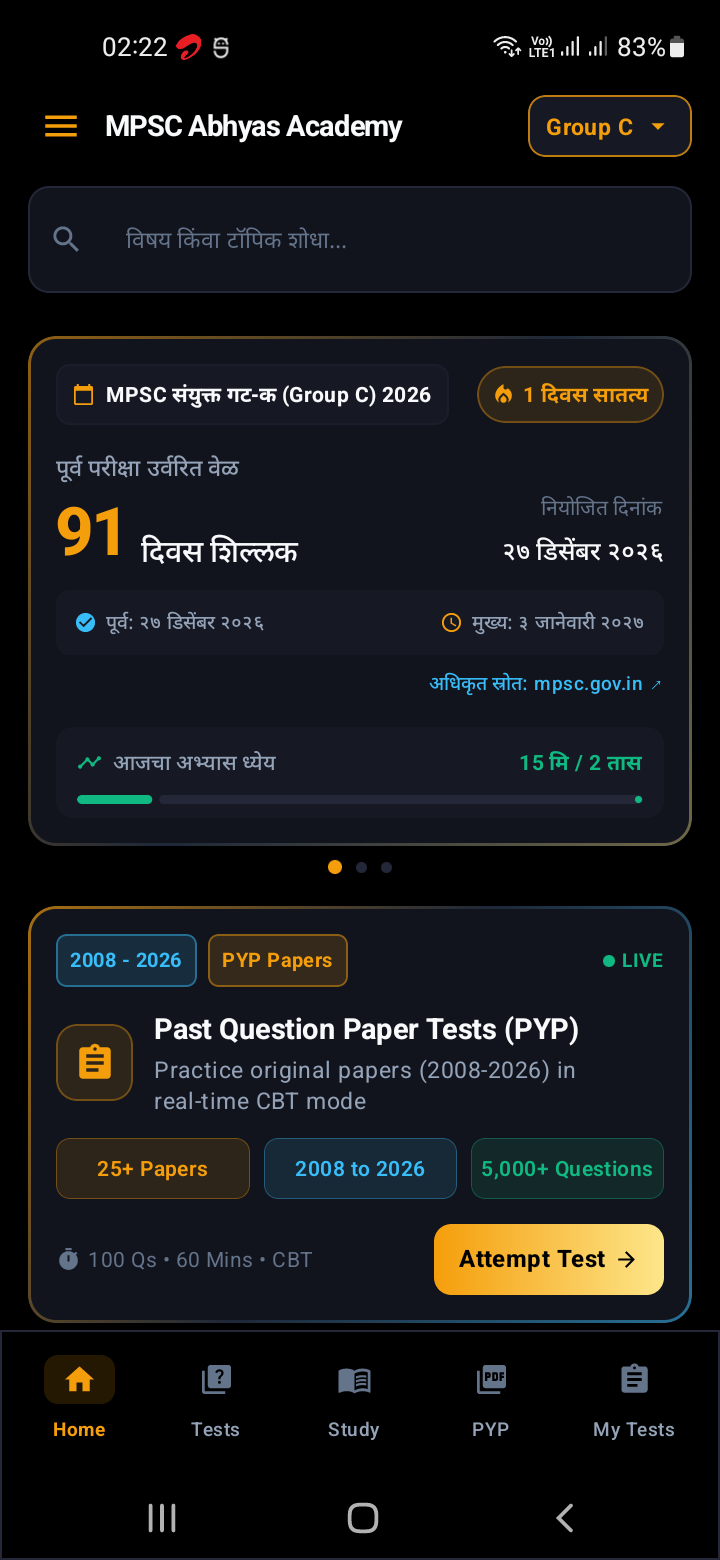
  • खऱ्या परीक्षेसारखा CBT अनुभव: ०.२५ नकारात्मक गुणांकन व अचूक टाइमर
  • विषय, विभाग व घटक टेस्ट्स: सखोल सराव आणि प्रत्येक घटकाचे विश्लेषण
  • सखोल विश्लेषण व अचूकता ट्रॅकर: प्रत्येक प्रश्नाचे सविस्तर उत्तर स्पष्टीकरण व ०.२५ निगेटिव्ह मार्किंग
★★★★★ ४.९ रेटिंग • गुगल प्ले स्टोअरवर उपलब्ध • १००% सुरक्षित व मोफत
MPSC Abhyas Dashboard
MPSC Abhyas Test Series
नवीन: विषय, विभाग व घटक टेस्ट्स